Platform Insights
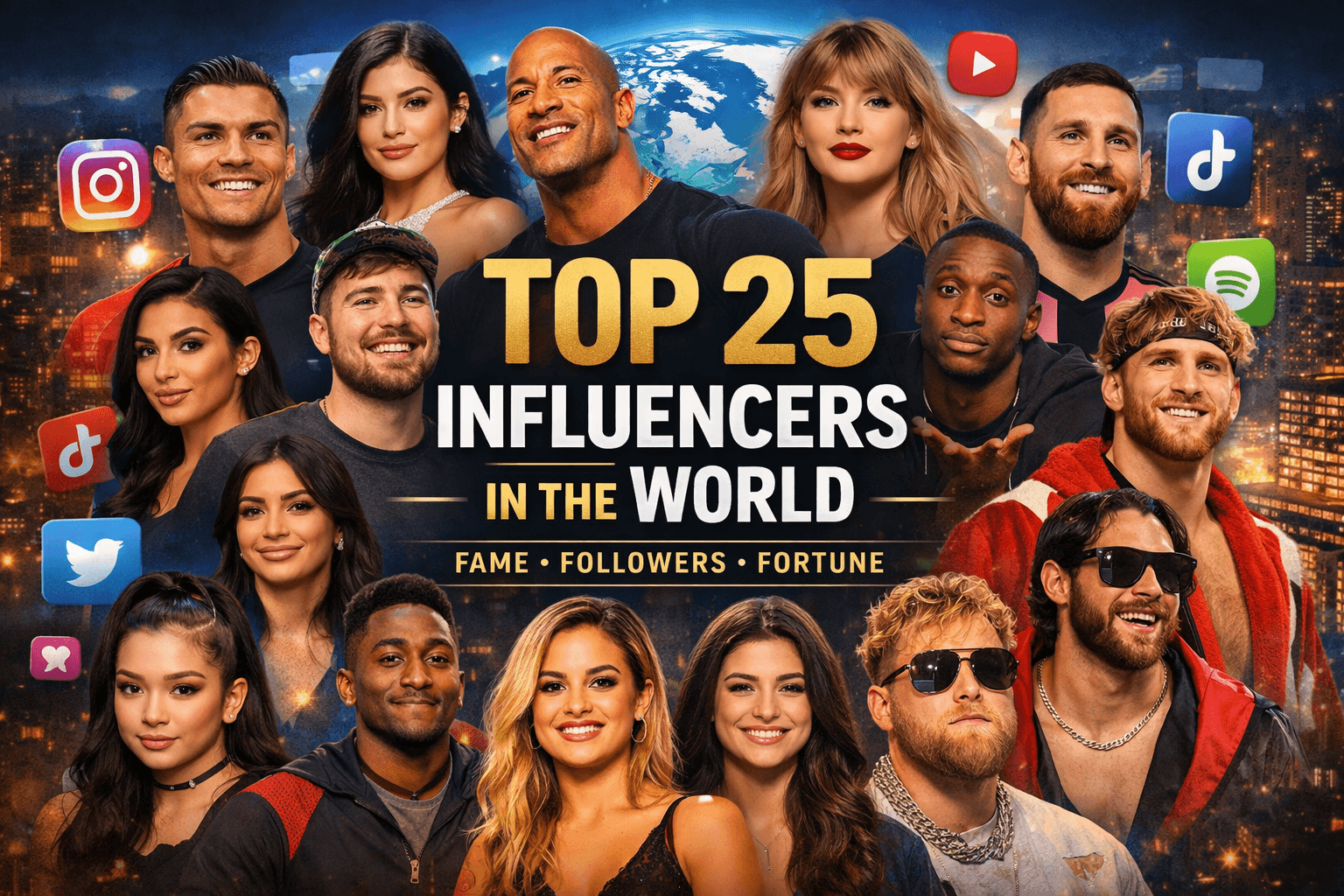
Top 25 Influencers in the World
Explore the top 25 influencers in the world, how they became famous, their follower counts across platforms, and how they earn money through brands, ads, and businesses.

Noor El-Masri
•
6 min
Influence is not just popularity. It is repeat visibility plus trust, multiplied by distribution. The biggest creators either started with a massive real-world advantage, like sports or entertainment fame, or they cracked a platform early with a format that scaled fast. The ones who last all build the same thing: a recognizable identity, a repeatable content engine, and a business layer that earns even when they are not posting.
Below are 25 of the most globally influential individuals today, with a deeper look at how they rose, why they stayed, and where the money actually comes from.
1) Cristiano Ronaldo
Ronaldo became famous through elite football, but his social dominance comes from turning performance into a lifestyle brand. His content is consistent: discipline, training, family, luxury, and winning. That consistency creates an “aspirational loop” where followers do not just watch, they attach identity to him. He also benefits from global language reach because sports is universal.
Followers: about 670M on Instagram alone, with even larger total reach across platforms.
Estimated annual earnings: roughly $275M in 2025 (salary plus endorsements).
How the money works: salary, long-term endorsement contracts, licensing, and premium brand campaigns where his distribution is the product.
2) Lionel Messi
Messi’s influence is built on legacy and trust rather than loud branding. His online presence is more “rare and high value,” which actually increases perceived prestige. After the World Cup era and Inter Miami spotlight, his influence expanded into global lifestyle and sponsorship narratives.
Followers: about 511M on Instagram (and higher combined across platforms).
Estimated annual earnings: around $135M on Forbes’ 2025 highest-paid athletes list.
How the money works: endorsements do a lot of heavy lifting, because his brand is stable and “safe” for global advertisers.
3) Selena Gomez
Selena’s growth comes from a rare mix: celebrity scale plus personal relatability. She maintains an emotionally “human” brand, which is why fans stay loyal through long gaps. She also built a business layer where the audience becomes distribution.
Followers: about 415M on Instagram.
Estimated annual earnings: commonly estimated in the $40M–$70M range (music, brand deals, and beauty business impact).
How the money works: beyond sponsorships, her biggest advantage is product ownership and brand equity, not per-post fees.
4) Kylie Jenner
Kylie is the clearest example of converting attention into owned commerce. She used social media as a storefront, not just a stage. Her content is simple: lifestyle + beauty + product framing. The reason it works is repetition and visual consistency, so the audience remembers the product without feeling “sold to.”
Followers: about 391M on Instagram.
Estimated annual earnings: often discussed as $50M–$120M depending on product cycles; exact annual numbers vary, but her wealth and business stakes are tracked by Forbes.
How the money works: ownership, licensing, and product margin outperform typical influencer sponsorship economics.
5) Dwayne Johnson
The Rock combines celebrity reach with influencer-style frequency and tone. His strongest strategy is “motivational consistency”: the audience knows exactly what emotional payoff they get. That predictability improves retention and brand value.
Followers: about 390M on Instagram, plus large TikTok reach.
Estimated annual earnings: commonly $50M–$100M+ depending on film cycles and brand activity.
How the money works: film income + brand ventures + social distribution that strengthens everything else.
6) Ariana Grande
Ariana’s influence scales because music fandom behaves like a network. Fans create free distribution through edits, clips, and trends, which means her visibility compounds without her needing constant posting.
Followers: about 372M on Instagram.
Estimated annual earnings: often estimated $30M–$70M depending on tours, releases, and licensing.
How the money works: music revenue, brand deals, and licensing that benefits from constant social circulation.
7) Kim Kardashian
Kim’s superpower is turning cultural attention into products with mass-market fit. Her brand is not “content first,” it is “product first,” and content is the delivery mechanism. She maintains a clean commercial aesthetic that brands love because it reduces risk.
Followers: well over 350M on Instagram.
Estimated annual earnings: widely estimated $50M–$100M+, but the bigger story is enterprise value. Skims reached a $5B valuation, and reported nearly $713M net sales (company level).
How the money works: ownership and enterprise value creation beats influencer fees.
8) Beyoncé
Beyoncé’s influence is scarcity-based. She posts less, but every appearance becomes an event. That “event attention” makes her launches feel bigger and more premium, which raises brand partnership value.
Followers: in the 300M+ range on Instagram (varies).
Estimated annual earnings: commonly $50M–$100M+ depending on touring and licensing years.
How the money works: music, touring, and luxury brand partnerships where prestige matters more than engagement rate.
9) Justin Bieber
Bieber’s social strength comes from early internet-era fame plus massive global fan communities that push content for him. His influence remains high because nostalgia and familiarity keep him culturally relevant.
Followers: 290M+ on Instagram range (varies).
Estimated annual earnings: often $20M–$80M depending on touring and catalog performance.
How the money works: catalog revenue, touring cycles, and high-paying endorsements.
10) Taylor Swift
Swift’s influence is community-driven. Her fans behave like a media network. Every album cycle generates endless user-generated content, which multiplies reach across platforms without traditional paid spend.
Followers: 280M+ on Instagram range (varies).
Estimated annual earnings: highly variable by touring cycle, often $50M–$200M+ in peak years.
How the money works: touring and IP ownership, with social acting as amplification.
11) Khaby Lame
Khaby rose because he made comedy universal. No language, no niche knowledge, just pure visual timing. He also kept the format extremely repeatable, which is why it scaled so well.
Followers: about 160M on TikTok.
Estimated annual earnings: commonly $10M–$25M from partnerships and commercial deals. (Large corporate deals have also been reported in mainstream press.)
How the money works: brand campaigns that want global reach without translation risk.
12) Charli D’Amelio
Charli benefited from perfect timing: early TikTok growth plus dance content that the algorithm and community both pushed. She then stayed relevant by moving into broader media and business, not just posting dances.
Followers: about 155M on TikTok.
Estimated annual earnings: Forbes listed $23.5M for her in its Top Creators list.
How the money works: sponsorships, product partnerships, and business moves that extend beyond TikTok.
13) MrBeast
MrBeast is not just an influencer. He is a media company with a creator face. He won by reinvesting relentlessly: bigger videos, bigger stakes, bigger retention. His content is engineered like product.
Followers: most-subscribed YouTube channel, around 465M subscribers at end of 2025, plus huge TikTok reach.
Estimated annual earnings: Forbes has named him highest-paid YouTuber; People reports $85M annual earnings figure associated with Forbes.
How the money works: ads are only one piece; snacks, consumer products, licensing, and media deals dominate.
14) Bella Poarch
Bella’s breakout was one of the most viral short-form moments ever. But what kept her relevant was switching from “viral face” to “music brand,” which creates repeat monetization beyond views.
Followers: about 92M on TikTok.
Estimated annual earnings: commonly $5M–$15M depending on deals and music activity.
How the money works: sponsorships plus music and licensing opportunities tied to identity.
15) Addison Rae
Addison grew from dance content, but she moved quickly into “mainstream crossover,” which increases pay ceiling. Her advantage is being brand-friendly and adaptable across formats.
Followers: about 88M on TikTok.
Estimated annual earnings: often $8M–$20M depending on brand and media work.
How the money works: endorsements, product partnerships, and entertainment projects.
16) Zach King
Zach King wins on shareability. His content is designed to be rewatched, shown to friends, and reposted. That makes his distribution unusually “evergreen.”
Followers: about 84M on TikTok.
Estimated annual earnings: commonly $5M–$15M depending on campaigns.
How the money works: premium branded content, because his “illusion style” integrates products without feeling like ads.
17) Will Smith
Will Smith’s social influence is a second career. He used celebrity familiarity, then adapted to short-form storytelling and spectacle. People watch because it feels like “Hollywood moments” in social format.
Followers: about 78M on TikTok.
Estimated annual earnings: widely variable; commonly $20M–$60M+ depending on film and partnerships.
How the money works: entertainment income amplified by social, plus major sponsorship campaigns.
18) PewDiePie
PewDiePie is a case study in early-mover advantage plus community intimacy. He built a loyal fanbase when YouTube felt personal, then kept that loyalty through years of consistent tone and inside jokes.
Followers: historically 100M+ YouTube subscribers (varies over time).
Estimated annual earnings: commonly reported historically in the $10M–$25M range across peak years.
How the money works: ads, sponsorships, and brand value of a long-term loyal audience.
19) Logan Paul
Logan’s rise was fueled by aggressive YouTube-era virality, but his real money expansion came from business and pay-per-view style moments. He pivoted from content to “event-driven attention,” which pays more.
Followers: tens of millions across platforms.
Estimated annual earnings: often $20M–$60M+, highly dependent on business and event cycles.
How the money works: brand ownership, sponsorships, and media deals that scale beyond posting.
20) Jake Paul
Jake Paul followed a similar path but leaned into boxing, where payouts can dwarf influencer fees. His influence is built around controversy, competition, and high attention narratives.
Followers: tens of millions across platforms.
Estimated annual earnings: often $30M–$80M+, heavily dependent on fight schedule.
How the money works: fight purses + sponsorships + brand partnerships that capitalize on attention spikes.
21) Emma Chamberlain
Emma made “being real” scalable. She changed influencer tone from polished perfection to casual authenticity, which brands now copy everywhere. She also built a product layer that makes her less dependent on algorithms.
Followers: 10M–20M+ range across platforms.
Estimated annual earnings: commonly $10M–$20M+ including brand and product business.
How the money works: premium brand deals plus consumer brand revenue.
22) Marques Brownlee (MKBHD)
MKBHD became famous by being consistently credible. In tech, trust is the moat. His videos feel like a professional review lab, which attracts both audiences and high-paying advertisers.
Followers: 10M–20M+ YouTube subscribers range (and large cross-platform reach).
Estimated annual earnings: commonly $5M–$15M depending on ads and sponsorships.
How the money works: ad revenue plus sponsorships that pay for authority and audience intent.
23) Huda Kattan
Huda is a top example of influencer-to-founder. She used beauty content to build demand, then built a cosmetics company to capture the margin. That jump from “promoter” to “owner” is why her economics are different.
Followers: 50M+ range on Instagram.
Estimated annual earnings: often $20M–$50M+ depending on business performance.
How the money works: product margin and brand equity, not just sponsorships.
24) Dude Perfect
They scaled because their content is family-safe, repeatable, and works internationally. Their retention is strong because viewers can watch without context, and their formats are easy to serialize.
Followers: 50M+ YouTube subscribers range.
Estimated annual earnings: often $20M–$40M+ from ads, sponsorships, and licensing.
How the money works: brand-safe sponsorships at scale, plus merchandise and touring.
25) David Dobrik
David’s rise came from fast-paced vlogs engineered for shareability and social proof. Even when posting slows, the brand remains valuable because the audience identity and cultural memory persist.
Followers: tens of millions across platforms.
Estimated annual earnings: commonly $10M–$25M+, depending on partnerships and business activity.
How the money works: sponsorships and business ventures tied to personality-driven influence.
What the Top 25 Have in Common
They all mastered one of these engines:
Prestige engine (sports and music icons) where scarcity and legacy create premium value.
Algorithm engine (TikTok breakout stars) where repeatable formats and high retention scale fast.
Media company engine (YouTube giants) where production, reinvestment, and business layers out-earn posting.